
To better understand traditional Chinese painting, I purchased brushes made from different natural hairs and in different sizes.
China has a long tradition of collecting stamps, so I also stamped my drawings.

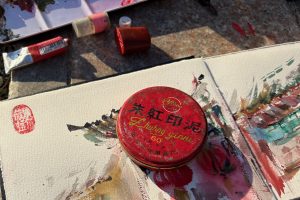
I painted the façade of the traditional Chinese shop where I had my seal engraved. A local man saw me painting and gifted me an old yinni can (seal paste).
I had a craftsman engrave my name on a natural red stone seal.
No art materials were allowed in Tiananmen, so I drew on my phone.

A passing Chinese man was happy to see me painting the Summer Palace in Beijing, so we exchanged a piece of art. He added his calligraphy to my drawing, and I gave him one of mine. Moments later, I saw him again, carefully holding my drawing with great care.
Despite the strict regulations in the Forbidden City, I was able to sketch using a slim Muji sketchbook and a pen I bought at the National Museum of China.
I used a traditional Chinese double-layer accordion sketchbook to practice controlling tonal variations with ink.

I used a large Chinese ink brush for the first time. It was extremely absorbent and difficult to control.
